
You’re not hiring slowly because the market is hard. You’re hiring slowly because you don’t trust yourselves.
By VDart Editorial | Talent Intelligence | February 26, 2026
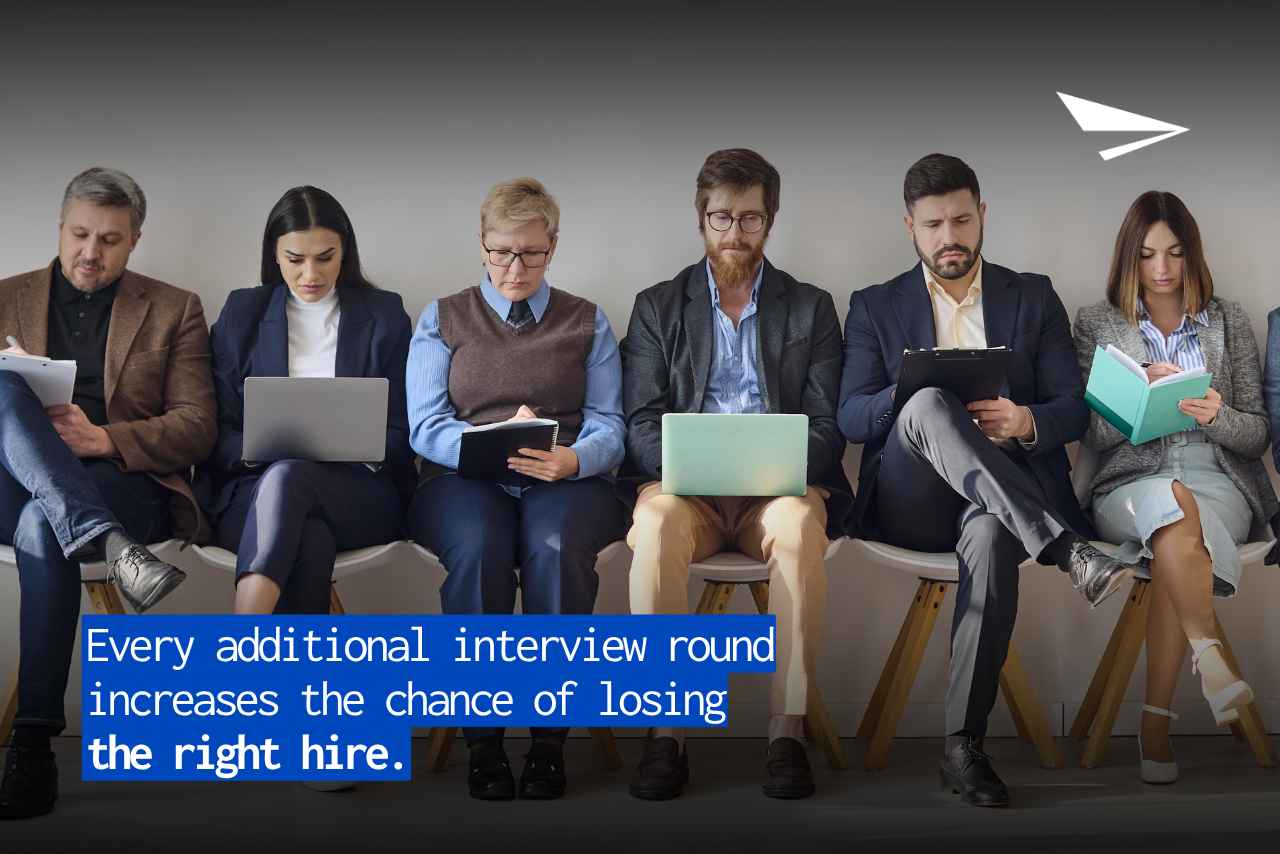
Round one: recruiter screen. Round two: hiring manager interview. Round three: panel with three team members. Round four: presentation to senior leadership. Round five: culture fit conversation with HR. Round six: “We just want one more person to meet you.”
The candidate started this process six weeks ago. They were genuinely excited after week two. By week five, they were updating their resume. By week six, they accepted a different offer, one that moved in eleven days, asked three questions, and made a decision.
Your organization is now reposting a role it should have closed a month ago. And somewhere in a debrief meeting, someone is going to suggest adding a technical assessment to the next round to make sure you don’t hire the wrong person again.
This is how interview inflation works. And it is quietly destroying your time-to-fill, your candidate pipeline, and your employer brand, all at the same time.
The data is not subtle
Hiring teams in 2026 are conducting 42% more interviews per hire than they did in 2021. That is not a marginal change. That is a structural shift in how organizations have decided to make hiring decisions, and it has produced exactly one measurable outcome: slower hires, not better ones.
Fifty-seven percent of job seekers say they lose interest in a role during a lengthy hiring process. Cutting just five days from the interview process produces a 20% improvement in candidate satisfaction scores. Most job seekers expect an offer within one to two weeks of beginning the interview process.
Those numbers describe a market where the candidate’s tolerance for organizational indecision is low and declining. They also describe a market where most organizations are operating in direct contradiction to what candidates will actually accept.
The median time-to-hire rose 22% to 45 days in 2025. The average recruiter is now managing 56% more open requisitions than three years ago, coordinating interview loops across more stakeholders, and collecting feedback through ATS workflows that fewer than half of organizations have automated. The administrative overhead of running a five-round interview process for every mid-level hire is not theoretical. It is burning recruiter hours that should be spent on sourcing, relationship-building, and pipeline development.
The math is simple and brutal: more rounds, more coordination, more time, and more candidates who accept other offers before you reach a decision. The hire you finally make is not better than the hire you would have made in round three. It is just later
Why hiring managers keep adding rounds
Interview inflation is not irrational behavior. It is a rational response to a broken incentive structure.
When a hire goes wrong, and every organization has had a hire go wrong, the postmortem almost always ends in the same place: we didn’t interview enough people, or we didn’t talk to enough stakeholders, or we moved too fast. The lesson internalized is that more process equals better outcomes.
It doesn’t. But the belief persists because bad hires are visible and attributable, while the cost of a slow hire is diffuse and invisible. Nobody gets called into a meeting because the open role sat unfilled for 70 days. Nobody’s performance review suffers because a candidate accepted a competing offer during round four. The organizational cost of hiring slowly is real but distributed; absorbed quietly by the team, the manager, the recruiter, and the business, without a clear line of accountability.
Over years, a two-round process becomes a five-round process. A two-week decision cycle becomes a six-week one. And the organization wonders why its time-to-fill keeps growing.
The complacency trap of 2026
The current labor market has added a specific accelerant to this dynamic that most TA leaders haven’t fully diagnosed.
With the quit rate at a historically low 2.0% and more applicants per posting than at any point since 2020, hiring managers feel something they haven’t felt in years: patience. There are more candidates. They’re not going anywhere. We can take our time and find the right person.
Except the right person, the genuinely strong candidate who has options, is not waiting. They are evaluating multiple organizations simultaneously, and they are making decisions based not just on the offer but on the process. A disorganized, slow-moving hiring experience signals something real about how an organization operates. Candidates read it correctly.
The candidates who stay patient through round six are not always the ones you most want to hire. The ones you most want to hire left after round three.
This is the complacency trap: the market conditions that create the illusion of hiring leverage are simultaneously destroying your ability to close the candidates who represent genuine upside.
What a disciplined hiring process actually looks like
The organizations that consistently close strong candidates fast share one characteristic above all others: they have defined, enforced, and made non-negotiable process standards.
Every role has a maximum interview round limit, typically two to three for individual contributor roles, and three to four for leadership roles, established before sourcing begins, not revised upward after round two because someone wants to add a stakeholder.
Every interviewer has a 48-hour feedback window that is enforced. Not requested. Not encouraged. Enforced, with a default “no objection” ruling if feedback is not submitted within the window, and a clear escalation path if a hiring manager repeatedly misses the deadline.
Offer approvals are pre-staged. The compensation band is validated before the final interview, not after. The approval chain for the offer is mapped and queued before a finalist is identified. When the final interview closes on a Friday, the offer goes out Monday morning, not after a week of internal routing.
The entire process is designed around one governing constraint: the candidate’s time is finite and their patience is not unconditional. Every unnecessary day the process runs is a day the probability of losing that candidate increases.
And in a market where 35% of recruiters reported time-to-fill increases in 2025, it is the strategy that separates organizations that consistently hire the people they want from those that consistently hire the people who were still available.
The question worth asking in your next debrief
After your next hire closes, or after the next candidate declines, ask one question before anyone suggests adding a round: what information would an additional interview have given us that we didn’t already have?
If there is a clear, specific answer, the round might be justified. If the answer is vague, such as “we just want to be sure,” “we want another perspective,” or “our CEO likes to meet finalists,” you have found your time-to-fill problem. It is not the market. It is not the candidate. It is the organization’s inability to make a decision with the information it already has.
Trust is not built by adding more interviews. It is built by designing a process that extracts the right information efficiently and making decisions with confidence.
The candidate who accepted the other offer would have been excellent. You had enough information to know that by round three.