
Why the blizzard of Feb 2026 is the strongest argument for smarter hiring
By VDart Editorial | Workforce Intelligence | Feb, 2026
Look outside your window today (if you’re anywhere from Maryland to Maine), and you’ll see the argument for flexible work buried under two feet of snow.
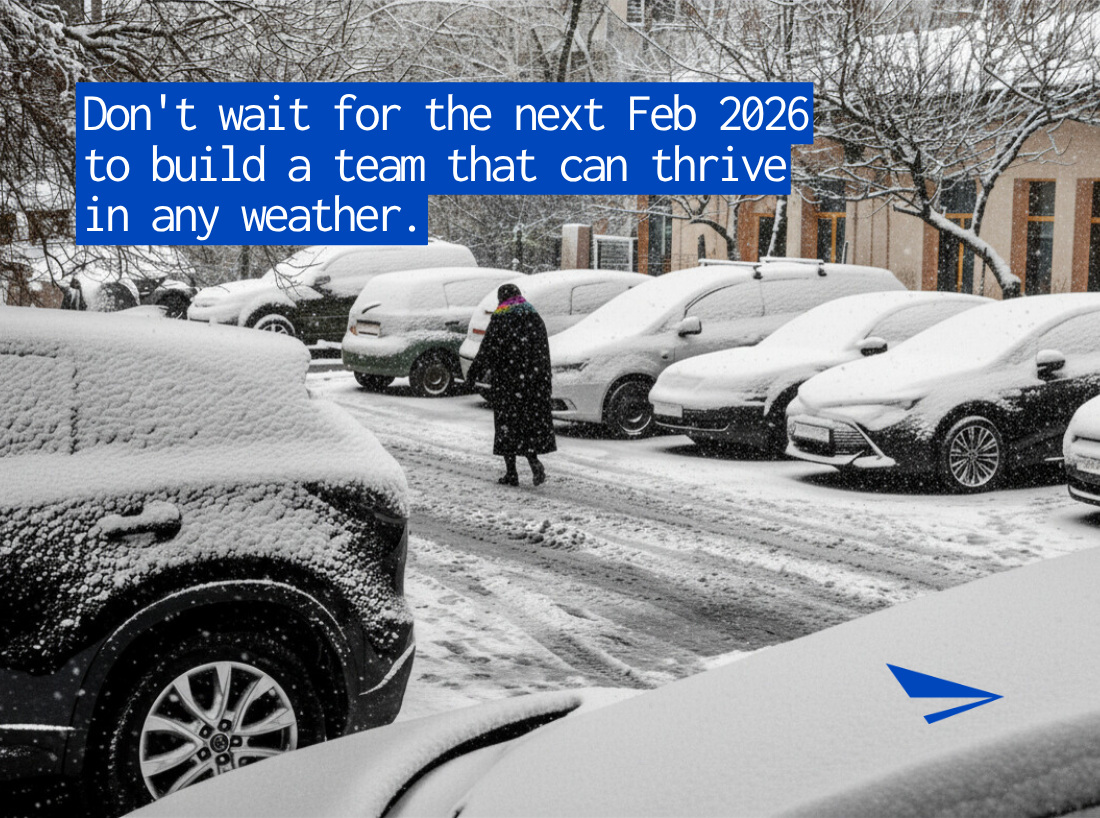
The storm that tore through the northeastern United States this week was not a surprise. It was not a freak event. Meteorologists called it the strongest storm in a decade. It dumped more than two feet of snow across the metropolitan Northeast, shattering accumulation records, immobilizing transit, and even leading the United Nations to postpone a Security Council meeting. More than 40 million people remained under winter alerts, blizzard warnings stretched more than 600 miles up the Eastern coast, and more than 600,000 utility customers lost power across the Northeast.
That is not a bad commute day; that is a total operational shutdown of the most economically dense corridor in the United States.
And yet, here is what happened to companies with a strong hybrid and remote infrastructure: absolutely nothing. Their teams opened their laptops, joined their standups, delivered their work, and closed their days as if the storm were background noise. Meanwhile, organizations that have spent the past two years dragging employees back to the office, loudly, publicly, and expensively, watched their Monday operations evaporate alongside the power grid.
And that’s what we call building a workforce designed for disruption.
The storm by the numbers: what getting stuck actually costs
Let’s be specific about what happened this week, because the economic damage doesn’t get nearly enough attention in the post-storm coverage.
More than 5,600 flights in and out of the United States were canceled on Monday alone, with a further 2,000 flights on Tuesday grounded, according to FlightAware. In New York City, several subway lines reported severe delays, the Long Island Rail Road was fully suspended until further notice, and New Jersey Transit suspended bus and rail services. Rhode Island’s TF Green International Airport halted all operations after receiving nearly 38 inches of snow, surpassing a record set in 1978.
And that’s just this week. Let’s not forget that January wasn’t much kinder. A massive storm in late January swept from Texas to Maine, with damages estimated in excess of $4 billion. That storm impacted more than 20 states, left more than one million customers initially without power, and caused hazardous travel, widespread power outages, and major disruptions to air and ground transit.
That is two once-in-a-decade storms in the span of four weeks.
The financial toll on individual commuters is staggering before a single snowflake falls. Full-time office and hybrid workers spend an average of $55 a day when they come in, including $15 on commuting and $18 on lunch alone. Multiply that across tens of thousands of employees, forced back to mandatory in-office schedules by C-suites performing productivity theater, and you begin to understand the tax that rigid work policies impose on workers: a tax that weather events collect with brutal efficiency.
Extreme weather doesn’t discriminate. It doesn’t care whether your CEO issued a return-to-office mandate. It doesn’t check your badge swipe policy at the door. It just shuts the door.
The hybrid case has never been stronger, or more ignored
Here’s where it gets maddening. The data on hybrid work efficacy has been overwhelming for years. And yet, the conversation in boardrooms and business media has been relitigated endlessly, as if the productivity question were somehow still open.
It is not open.
Approximately 34.3 million Americans worked from home or remotely for pay as of April 2025, roughly 21% of the U.S. workforce. Remote workers save an average of 55 minutes every day by avoiding commuting, and many reinvest that time in work or personal activities that improve their overall well-being. Remote work delivers almost the same productive hours in less time: 6 hours 55 minutes total translating to 5 hours 12 minutes productive, compared to office work’s 7 hours 44 minutes total yielding only 5 hours 17 minutes productive. This results in an extra 49 minutes added to the day, yet with a lower active share and over 2 hours of overhead and idle time.
Read that again. Office workers spend nearly an hour more of their day working, and they produce almost nothing extra for it.
A comprehensive study of over 423,000 new U.S. job postings found that 24% of new job postings in Q4 2025 were hybrid and 11% were fully remote. Among the job seekers surveyed, just 16% said their top choice is an in-office job, and only 25% are even considering pursuing a job requiring five days in the office. The market is speaking clearly.
Yet here we are, with 83% of global CEOs anticipating a full return to in-person work by 2027, even as their employees wake up to a foot of snow outside their windows, their subway suspended, their commuter rail in damage assessment mode, and their productivity humming along perfectly from the kitchen table.
The disconnect is breathtaking. And it’s costing companies top talent, operational continuity, and money, often simultaneously.
The RTO trap: betting the operational continuity game on good weather
The return-to-office movement, as it has been executed by many large employers, is essentially a weather bet. It says: we believe the value of in-person presence is high enough to absorb the operational losses we’ll incur when the weather doesn’t cooperate.
That bet looks increasingly bad in 2026.
Approximately 46% of work-from-home workers say they’d likely leave their job if remote work ended. That’s nearly half your talent pool walking out the door over a policy decision. And that calculation was made before two consecutive historic storms turned the morning commute into a liability.
The irony runs deeper. The organizations loudest about RTO mandates, many of them financial institutions and legacy enterprises concentrated precisely in New York, Boston, Philadelphia, and Washington, operate in the exact geographies that bear the heaviest weather risk. They’ve concentrated their operational dependency on commuting infrastructure that, as this week proved, can be rendered completely nonfunctional in 24 hours.
On average, full-time in-office and hybrid workers have a 31-minute commute. Nearly a third of them spend 31 to 45 minutes commuting one way. That’s fine in October. In February, in a nor’easter with hurricane-force wind gusts at 83 mph, it’s a medical emergency waiting to happen. Massachusetts State Police responded to more than 350 disabled motor vehicles by mid-afternoon on Monday alone.
This is not about employee preference. This is about operational risk management. And organizations that treat workforce flexibility as a culture war rather than a business continuity strategy are leaving themselves catastrophically exposed.
Hiring for the rainy day (actually, the snowy one)
Now we get to the part that separates reactive organizations from genuinely resilient ones.
The blizzard of February 2026 is not an argument to simply allow remote work when the weather is bad. It’s an argument for building your workforce infrastructure around the expectation that disruption is the baseline, not the exception.
This is what we at VDart call “hiring for the rainy day,” or in this week’s case, the snowy one. In 2026, organizations are rethinking how they build teams that can withstand uncertainty, adapt to change, and remain consistent under pressure. Workforce resilience has become a central hiring priority, especially in industries where continuity, reliability, and experience directly impact business outcomes.
That’s the framing. Here’s what it actually means in practice.
First: Hire for geographic and operational flexibility, not just skill. The talent strategy that made sense when you assumed your workforce would be physically present five days a week does not make sense when a storm can shutter an entire metropolitan region with 48 hours’ notice. Distributed hiring, which involves deliberately building teams across multiple geographies with different weather profiles, time zones, and commute dependencies, is no longer just a diversity initiative. It’s a business continuity strategy.
Relying on a single talent hub is increasingly risky. Organizations that are purposeful in spreading their workforce across multiple regions with different geopolitical, regulatory, and economic profiles are more apt to enjoy built-in resiliency that protects operations against localized disruptions. Weather risk is the most basic version of this principle, but it’s also the most universally applicable.
Second: Build the infrastructure before you need it. Here’s the failure mode that repeats itself every winter: companies spend eleven months operating as though their teams will always be in the office, then scramble to cobble together remote work arrangements when the storm hits. The result is chaos: technology that doesn’t work, managers who don’t know how to lead distributed teams, collaboration tools nobody has used, and productivity that actually does collapse.
The most successful companies entering 2026 are intentional and data-driven in how they structure their flexible work policies. Poorly defined remote-work policies remain top contributors to employee frustration, burnout, and turnover. You can’t activate resilience you haven’t built. The time to invest in hybrid infrastructure is when the sun is shining and the subway is running, not when you’re staring at a blizzard warning.
Third: Rethink what you’re evaluating when you hire. The candidate who can thrive in structured in-office settings and the candidate who can maintain peak performance while operating independently through ambiguity and disruption are not the same person. In 2025, the most critical talent pipeline wasn’t LinkedIn; it was the internal talent marketplace powered by an organization’s own learning systems. As the cost of turnover became impossible to ignore, companies shifted focus from constant external hiring to developing and retaining the people they already had.
Fourth: Stop treating flexibility as a perk and start treating it as architecture. Hiring is no longer transactional; it is a strategic function that shapes business resilience. Flexibility isn’t something you offer to attract candidates or reward top performers; it’s the load-bearing structure of a workforce that can absorb disruption and keep delivering. Organizations that design their teams around that premise, rather than bolting flexibility on as an afterthought, are the ones that maintained full operational continuity while their competitors were watching their Monday vanish under two feet of snow.
What the storm revealed about your organization
The blizzard is a diagnostic. What happened to your team’s productivity on Monday, February 23, 2026, tells you everything you need to know about the actual resilience of your workforce strategy.
The blizzard is a diagnostic. What happened to your team’s productivity on Monday, February 23, 2026, tells you everything you need to know about the actual resilience of your workforce strategy.
If your team kept working without disruption, you have built the infrastructure, the culture, and the hiring practices that a 2026 operating environment demands. You are positioned for the next disruption, whatever form it takes.
If your Monday went dark, you have a structural problem that the next storm will expose again, and the one after that. And the problem is not the weather.
Organizations that predict workplace trends are more likely to excel at driving change (61% vs. 45%). That translates into better operational efficiency and reduced costs. Predicting that winter will happen in a place called the Northeast is not a stretch. Designing your workforce to survive it is simply what professional organizations do.
The storm passed. Roads are being cleared. Subway service is resuming. But the strategic question it raised is still sitting on your desk, waiting for an answer.